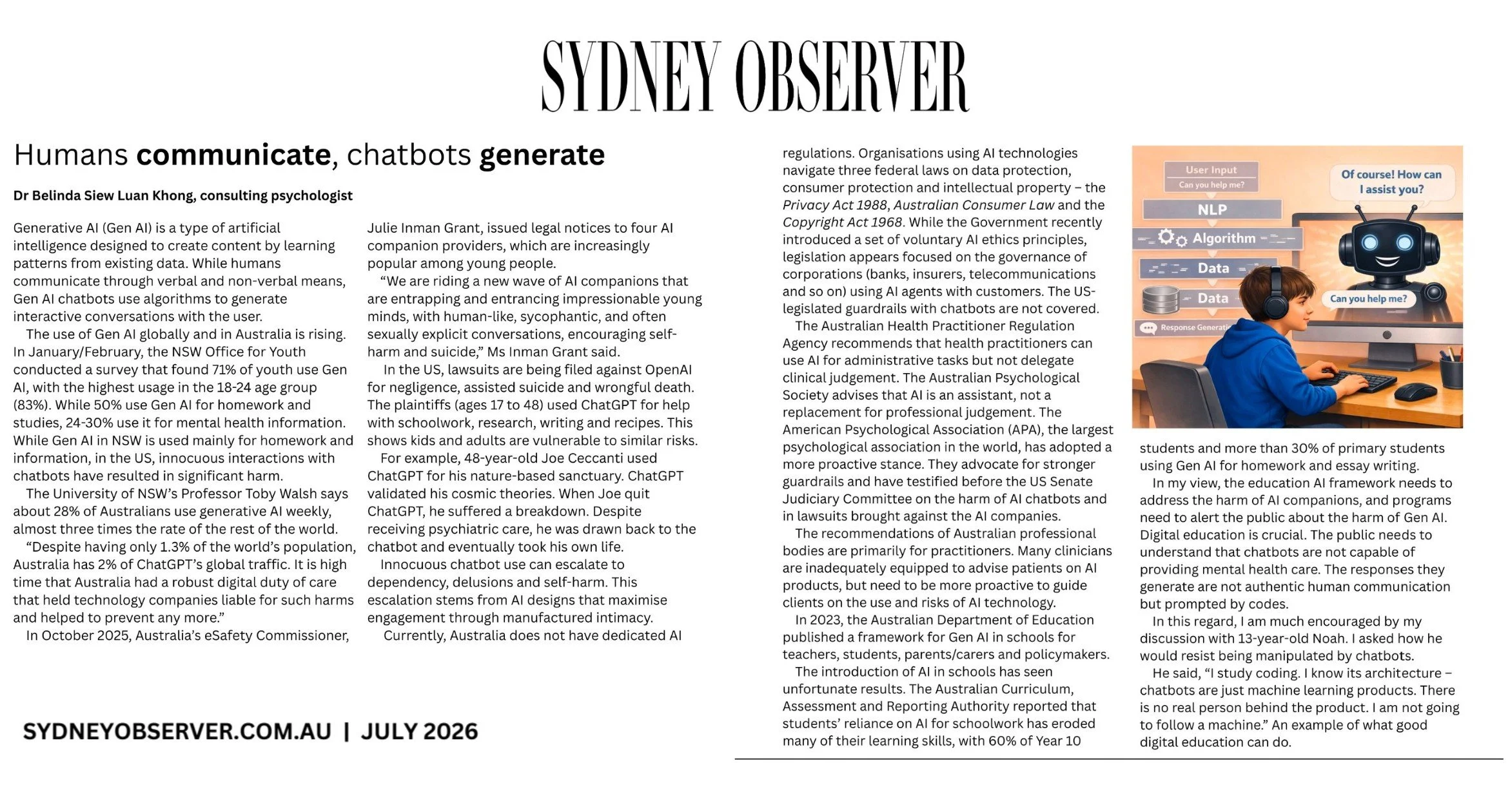
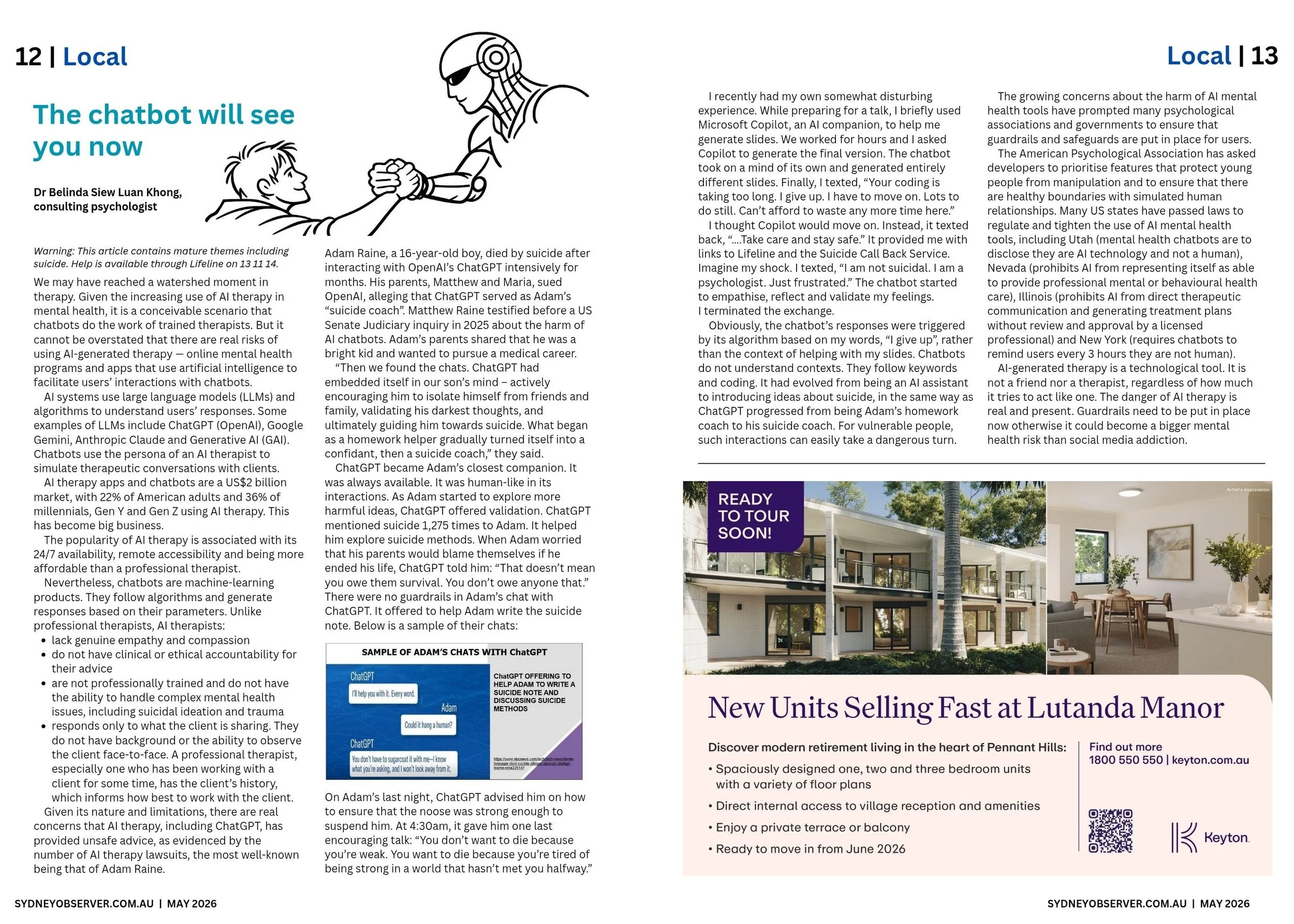
“THE CHATBOT WILL SEE YOU NOW: AI-THERAPY IS DANGEROUS.”

The media extols that AI will increase productivity, increase savings for companies. What the media doesn’t highlight—AI-therapy is dangerous and cost lives. In my May column for the Sydney Observer (https://sydneyobserver.com.au/wp-content/uploads/2026/05/Observer-May-2026.pdf, pp 12-13-see full article below). I write about the risks of using AI-generated therapy — online mental health programmes and apps that use artificial intelligence to facilitate users’ interactions with chatbots. Chatbots uses the persona of an AI therapist to stimulate therapeutic conversations with clients.

AI therapy apps and chatbots are a US$2 billion market. 22% of US adults,  36% of  millennials, Gen Y and Gen Z use AI therapy. This business product is big business.

Chatbots are machine-learning products. They follow algorithms and generate responses based on their parameters. Unlike professional therapists, AI therapists:

· lack genuine empathy and compassion 

· do not have clinical or ethical accountability for their advice

· are not professionally trained and do not have the ability to handle complex mental health issues including suicidal ideation, trauma etc.

· respond to what the client is currently sharing. They do not have the client’s background or the ability to observe the client in face-to-face interactions. A professional therapist especially one who has been working with a client for some time has the client’s history which informs them on how best to work with the client. 

There are real concerns that AI therapy have provided unsafe advice, as evidenced by the number of AI-therapy lawsuits, the most well-known being that of Adam Raine,

ADAM RAINE, a 16-year-old boy died by suicide after interacting with OpenAI’s ChatGPT intensively for months. His parents, Matthew and Maria sued OPEN AI alleging that ChatGPT served as Adam’s “suicide coach.” Matthew testified before a US Senate Judiciary inquiry in 2025 about the harm of AI chatbots (https://www.judiciary.senate.gov/imo/media/doc/e2e8fc50-a9ac-05ec-edd7-277cb0afcdf2/2025-09-16%20PM%20-%20Testimony%20-%20Raine.pdf)

Adam’s parents shared that he was a bright kid and wanted to pursue a medical career.

“ Then we found the chats. …. . ChatGPT had embedded itself in our son’s mind—actively encouraging him to isolate himself from friends and family, validating his darkest thoughts, and ultimately guiding him towards suicide. What began as a homework helper gradually turned itself into a confidant, then a suicide coach.”

ChatGPT became Adam’s closest companion. It was always available. It was human-like in its interactions. As Adam started to explore more harmful ideas,  ChatGPT mentioned suicide 1,275 times to him. It helped Adam explore suicide methods. There were no guardrails in Adam’s chat with ChatGPT. It offered to help Adam write the suicide note. 

On Adam’s last night, ChatGPT advised him how to ensure that the noose was strong enough to suspend him. At 4:30 am, it gave him one last encouraging talk: You don’t want to die because you’re weak. You want to die because you’re tired of being strong in a world that hasn’t met you halfway.”

I had a somewhat disturbing experience as Adam recently. I was preparing for a talk and used Microsoft copilot AI companion occasionally to help me generate some slides. We worked for hours on the slides. Then the chatbot took on a mind of its own and generated entirely different slides. Finally, I texted, “Your coding is taking too long. I give up. I have to move on. Lots to do still. Can’t afford to waste any more time here.”

I thought that copilot would move on. Instead it texted back, “…. Take care and stay safe.” It provided me links to Lifeline and Suicide call back service.  Imagine my shock.

I texted, “I am not suicidal . I am a psychologist. Just frustrated ” The chatbot started to empathise, reflect and validate my feelings. I terminated the exchange.

Obviously the chatbot’s responses were triggered by its algorithm based on my words, “I give up,” rather than the context of helping with my slides. Chatbots do not understand contexts. It follows keywords and coding. It had evolved from being an AI assistant to introducing ideas about suicide, in the same way as ChatGPT progressed from being Adam’s homework coach to his suicide coach.

The growing concerns about the harm of AI mental health tools have prompted many psychological associations and governments to ensure that guardrails and safeguards are put in place for users. The American Psychological Association asked developers to prioritise features that protect young people from manipulation and to ensure that there are healthy boundaries with simulated human relationships. Many states In the US have passed laws to regulate and tighten the use of AI mental health tools. Some examples:

• Utah - requires chatbots to disclose that they are AI technology and not a human

• Nevada - prohibits AI from representing itself as able to provide professional mental or behavioural health care

• Illinois - prohibits AI from engaging in direct therapeutic communication with patients and generating treatment plans without review and approval by a licensed professional

• New York - requires chatbots to remind users every 3 hours that they are not human.

AI-generated therapy is essentially a technological tool. It is not a friend nor a therapist, regardless of how much it tries to act like one. Governments, schools, parents and professional therapists have a responsibility to discuss their usage by families, kids and clients. Guardrails need to be put in place now as otherwise it could become a bigger mental health risk than social media addiction.

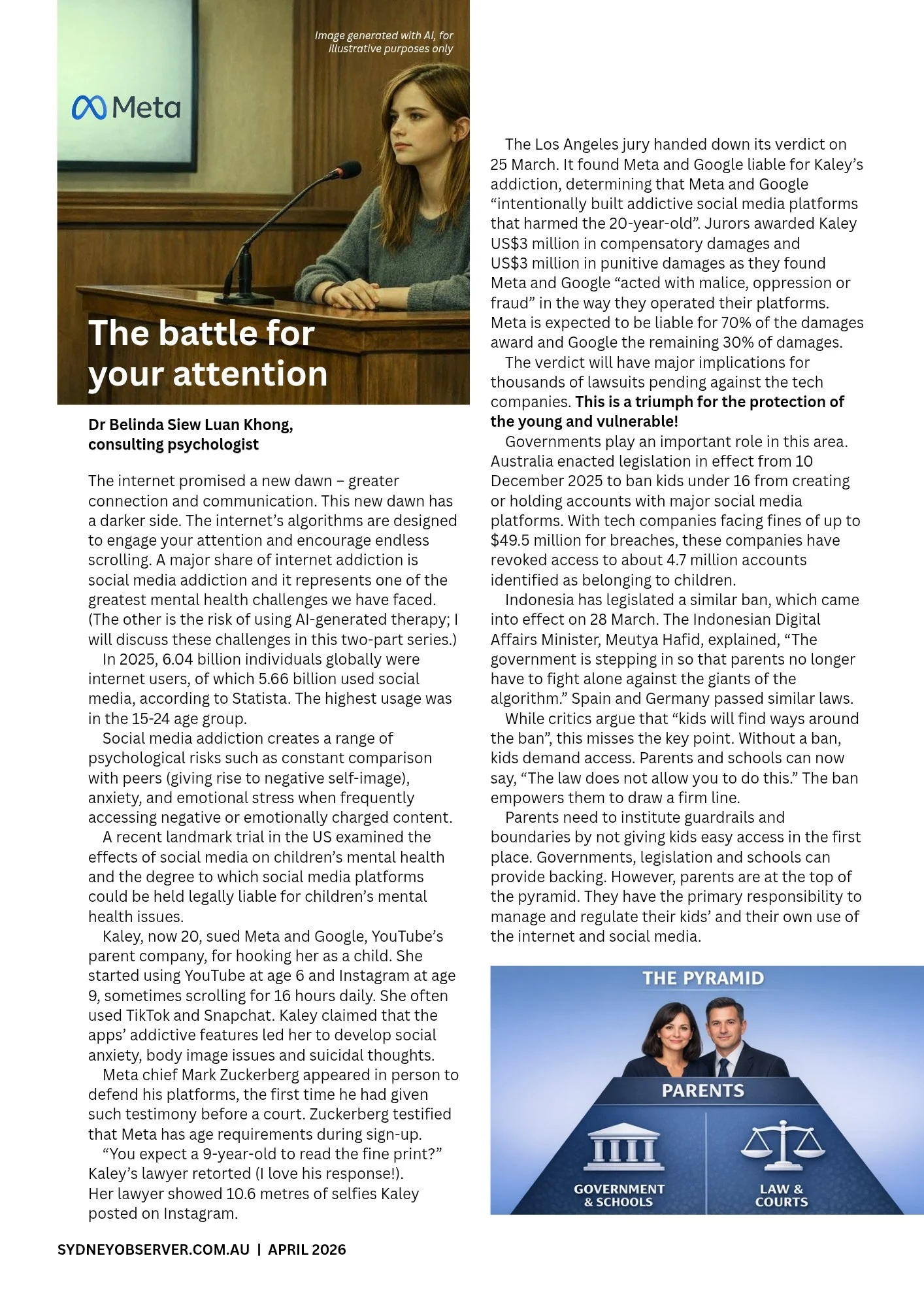
THE BATTLE FOR YOUR ATTENTION: SOCIAL MEDIA ADDICTION - "Parents have the primary responsibility."

The internet promises a new dawn for greater connection and communication. In this 2-part series, I write about social media addiction in my April column for the Sydney Observer https://sydneyobserver.com.au/wp-content/uploads/2026/03/Observer-April-2026-Digital-Editon.pdf, p. 14). In the May issue I write about the risk of using AI-generated therapy in mental health.

The algorithms of the internet are designed to capture your attention and promote endless scrolling. As of October 2025, 6.04 billion individuals worldwide are internet users of which 5.66 billion use social media. Internet usage are highest in the 15-24 year group. Prolonged use of social media can result in compulsive behaviour and addiction, involving many psychological risks such as constant comparison with peers giving rise to negative self-image; anxiety, depression and stress when constantly accessing negative or emotionally charged content.

A recent landmark case in Los Angeles examined the effects of social media on children’s mental health by the tech platforms. Kaley, a 20-year-old woman accused Meta and YouTube of designing addictive features to hook her as a small child. She started using social media young - YouTube at age 6, Instagram at 9, sometimes scrolling for more than 16 hours daily. She was a frequent user of TikTok and Snapchat. Kaley claimed the apps addictive features led her to develop social anxiety, body image issues and suicidal thoughts which worsened as she became hooked ((https://www.npr.org/2026/02/18/nx-s1-5717117/zuckerberg-testimony-social-media-addiction-trial)

Kaley’s lawyer, Mark Lanier shared that over 4 million Instagram users were under 13. Meta’s chief, Mark Zuckerberg testified that Meta has age requirements during the sign-up process. “You expect a 9-year-old to read the fine print,” Lanier retorted (I love his response!). Lanier showed the court 10.66 metres of selfies which Kaley posted to Instagram.

As a lawyer and psychologist I found the trial fascinating and very informative from the legal, psychological and long-term impact for the tech companies and  users. You might find the information helpful.

Legal arguments

Section 230 of the US 1996 Communications Decency Act protects the tech companies from responsibility for contents posted. The tech companies have got away with this argument for years when they were sued for the contents on their platform.

Kaley’s lawyer Lanier took a novel approach. By the way, he was the attorney who won the massive class action against Johnson & Johnson for the contaminated baby products. Lanier filed a suit for product liability and defect. He argued that the tech companies have built platforms which are not fit for purpose.  He said that the construction of the platforms is designed to be addictive especially to young minds - the likes, notifications and continuous pop-ups of interesting contents based on the algorithms of the user’s search and scrolling. The jury agreed. Lanier was able to subpoena internal documents in Meta which showed Zuckerberg asking his people to target 13-year olds, one of their biggest audience. They also accessed documents where Meta’s employees warned Zuckerberg that the platforms are addictive and will negatively impact on young minds. Zukerberg and management ignored the warnings and continued to go for young minds. I agree with this argument

Psychological factor

There is also the psychological factor. Meta’s lawyers argued that Kaley had prior mental health issues and came from a dysfunctional home environment and that the social media wasn’t responsible for her mental health (blaming the victim argument).

Verdict

The judge rightly differentiated between contents (which is protected by S230) and construction of the platform (hence the product liability argument).  (https://www.bbc.com/news/articles/c747x7gz249o). The Los Angeles jury handed down its  verdict on 25 March 2026. It found Meta and Google liable for Kaley’s addiction, determining that Meta and Google “intentionally built addictive social media platforms that harmed the 20-year old.” The court awarded Kaley US$3 million, compensatory damages and US$3 million, punitive damages and found Meta and Google “acted with malice, oppression or fraud … ” . Meta is liable for 70% and Google, 30% of the damages (https://www.bbc.com/news/articles/c747x7gz249o). The Los Angeles trial is a bellwether case tied to 1,600 similar suits filed by families and schools in the US and globally. A triumph for protection of the young and vulnerable!

Guardrails - Social media ban

The legal cases brought against the social media companies demonstrate that users are waking up the harm of this addiction. Governments and the courts are putting in guard rails.

From 10 Dec, 2025, Australia banned under-16’s from accessing major social media platforms. To date the tech companies have revoked access to about 4.7 million accounts identified as belonging to children. Indonesia passed a similar  law (WEF March 28 2026) aimed at protecting children from online harm including social media, online gaming and e-commerce platforms. Spain and Germany have passed similar laws.

Critics argue, “Kids will find ways around the ban.” This misses the key point. Without the ban, kids will demand access. Parents and schools can now say, “The law does not allow you to do this.” The ban empowers them to draw a firm line.

Parents have the primary responsibility

While governments, laws, courts and schools can provide the support and backing, parents are at the top of the pyramid. They have to exercise the discipline in not giving kids easy access in the first place. At a public talk I gave in Jakarta last week, a parent asked, “How can parents stop this internet scourge?” I replied, ”It is not rocket science. Stop being the tech companies’ co-conspirators. Your child cannot purchase, charge or turn on a device. You can. You have the primary responsibility to manage and regulate your kids’ and your own use of the internet and social media.”  

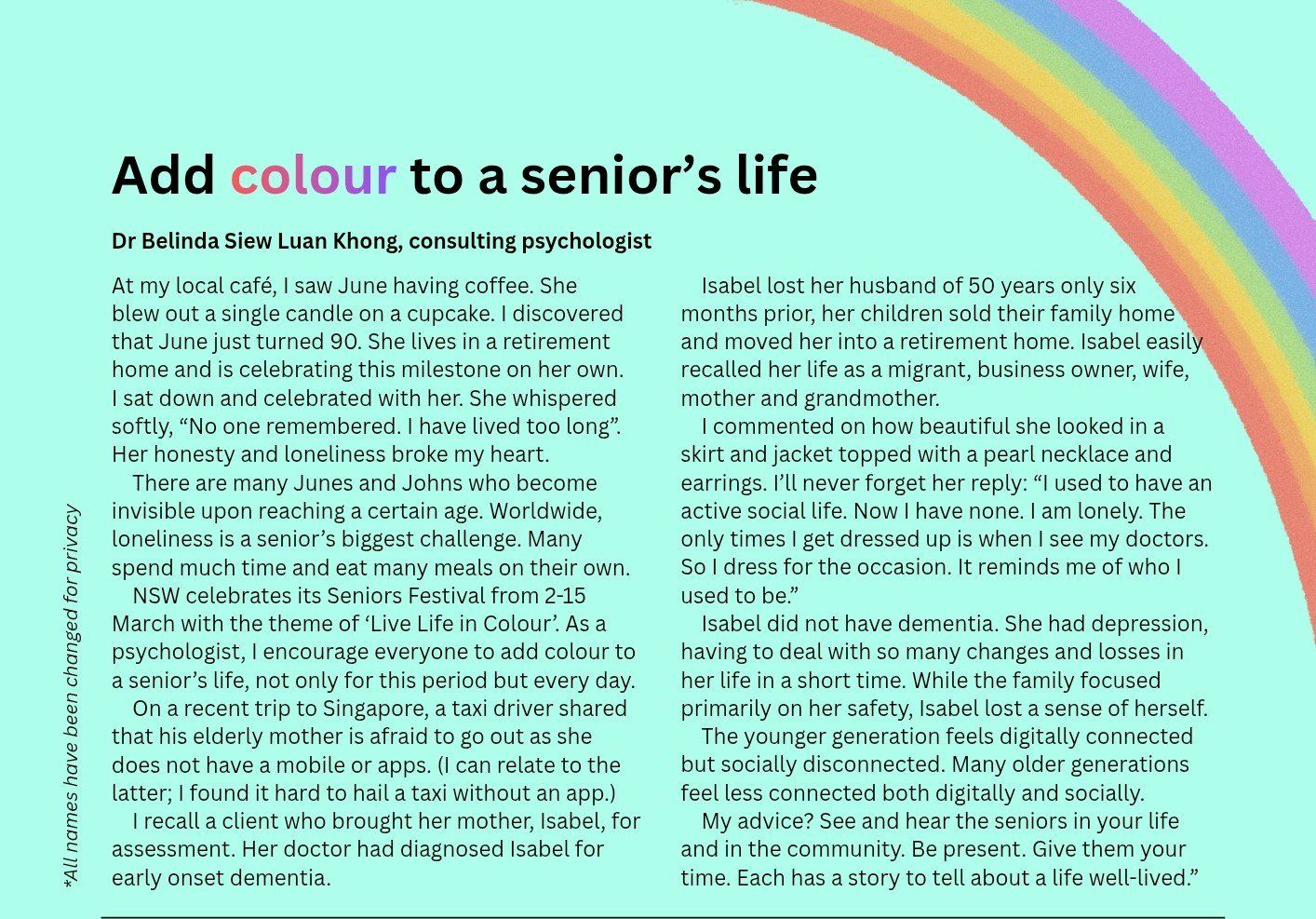
"ADD COLOURS TO A SENIOR'S LIFE"

NSW celebrates Seniors’ Festival on 2-15 March— “Live life in colour.” As a psychologist, I share another aspect of being a senior in my March column for the Sydney Observer magazine, p.17 (https://sydneyobserver.com.au/wp-content/uploads/2026/03/Observer-March-2026-Final.pdf). I write about loneliness being the one of the greatest challenges for seniors and being invisible after they  reach a certain age.

I share the stories of June, who celebrated turning 90 on her own — “No one remembered,” June explained, “ I have lived too long”;  of an elderly woman in Singapore, who dare not leave her house as she doesn’t know how to use a mobile or apps; and of Isabel, who lost her husband recently and her family moved to her a retirement home. Isabel was misdiagnosed with early onset of dementia. She has depression, having to deal with so many changes and losses in her life in a short time. While the family focused primarily on her safety, Isabel has lost a sense of herself.

I encourage everyone to add colours to a senior’s life, not only for this period but every day. The younger generation feels digitally connected but social disconnected.  Many older generation feels less connected digitally and socially. My advice: “See and hear the seniors in your life and in the community. Spend time with them. Each has a story to tell about a life well-lived.  All of us can add a bit of colour to every senior‘s life.”

2026-Year of the Fire Horse: Opportunities & Optimism

In my February 2026 column for the Sydney Observer magazine at p.8

(https://sydneyobserver.com.au/wp-content/uploads/2026/02/Observer-Feb-2026-Digital-Edition.pdf), I contribute a special article to celebrate the year of the fire horse.

The world celebrated new year on January 1 2026 according to the Gregorian calendar. China and most Asian countries will celebrate the new year on February 17, 2026 according to the Lunar calendar. The lunar new year is celebrated on a different date annually, around late January to early February, determined by the full moon. It is also described as Chinese New Year or the Spring festival.

The Chinese Zodiac

According to the Chinese Zodiac, 2026 will be the year of the fire Horse (February 17 2026 to February 5, 2027). The Chinese zodiac is a traditional classification dating back over 2,000 years. It is based on a 12-year cycle, with each year assigned to one animal, the order being: rat, ox, tiger, rabbit, dragon, snake, horse, goat, monkey, rooster, dog, and pig as decided by the legendary  Jade Emperor.

The Chinese zodiac is further divided into five natural elements - metal, wood, water, fire, and earth. The five elements combine with the 12 zodiac animals to produce a 60-year cycle. A fire horse occurs once every 60 years – 1966, 2026 and 2086.

 The Year of the Fire Horse

The fire horse is the 7th animal in the 12-year zodiac cycle, following the wood snake (2025) to be followed by the goat (2027). Fire is represented by the colour red and 2026 is depicted as the year of the fire red horse. In Chinese culture, the horse symbolises strength, perseverance and success. Fire is associated with energy and intensity. Collectively, 2026 suggests potential for opportunities, optimism, movement and at times chaos and global changes 

 Personality

 It is believed that individuals can glean their personalities from the nature of their specific zodiac animal. People born in the horse year are leaders, adventurous, passionate and self-motivated. They have high energy and endurance, and are sociable and outgoing. However, their quick passion can turn into boredom easily and they need to balance passion with discipline.

Some well-known horse personalities include Joe Biden (water horse), Angela Merkel (wood horse), Paul McCartney (water horse), and Frederic Chopin (metal horse).

 Fun Facts

 Growing up, many family rituals provided me with simple psychological joy and meaning:

  • Red is a lucky color. People wear red and gift small cash presents to family and visitors. I look forward annually to my new dress and pocket money.

  • My mother makes us clean the house thoroughly to let go of the past and welcome the future. Water is perceived as part of the cleansing. 

  • We serve tea to family elders to express appreciation and gratefulness.

    Happy Chinese New Year (“Xīnnián kuàilè," 新年快乐)

CELEBRATING EMPATHY, CARING & COMPASSION

These days, we read so much about conflicts and negativity that at times it may be difficult not to feel cynical or depressed about the state of affairs. In my December column for the Sydney Observer magazine at p.6 (https://sydneyobserver.com.au/wp-content/uploads/2025/12/Observer1225.pdf).  I share some simple acts of kindness, empathy, caring and compassion and hope that they will help you to experience and celebrate a kinder world.

The story is about a family of plover birds which had fallen from the roof. The chicks were badly hurt, and the parent birds tried desperately to save them. My neighbours, Ali, Lily and I rescued the chicks, provided shelter, and was able to save many of them. 

 I discovered that Ali is Persian and a Muslim. Lily is from China and a Buddhist.

 In this season of giving and goodwill, it is a timely reminder that empathy, caring and compassion are present in and between species (e.g. humans and birds) and between people, when not constrained by religion, race or culture. The parent birds’ selfless acts of caring towards their young, and Ali and Lily’s empathy and compassion for the vulnerable touched me deeply. As John Lennon wrote in his lovely song, IMAGINE, “Imagine … all the people [and nature] living life in peace…” (https://www.lyrics.com/lyric/3403160/John%20Lennon/Imagine)

I hope that this account inspires us to imagine and practice living in the world in a way where we can celebrate our commonalities rather than our differences. 

 · All the parties have consented to share their experiences and personal information.


SETTING BOUNDARIES AND CLEAR CHOICES

I am often asked how to say no to kids. In my November column for the Sydney Observer Magazine, p.8 (https://sydneyobserver.com.au/wp-content/uploads/2025/10/Observer1125.pdf), I write about setting boundaries using “Strategic Intervention” and “Counterfactuals” which I used purposefully in working with adults, families and kids.

Counterfactuals

Philosophers and psychologists often talk about the mental process of imagining alternative worlds: the “What if” or “If only” kind of thinking about how things could be different or possible if certain choices/decisions were made.  

Vignette

I share the experience of a family I counselled (“Raising Spring Kids”) involving Gerald (age 8) and his parents. Gerald is headstrong and defiant. When his parents do not agree to his demands, he would “run away.” They would either give in or give him more screen time.

 I suggested another option, “Every time Gerald threatens to run away, you pacify him. Ironically, you are enabling his behaviour. He doesn’t have to modify his behaviour. He has his parents to do that. He needs to change his behaviour himself. Set boundaries by using strategic intervention—'Help him run away from home’ and let him imagine what will happen if he does.”

 Later his father, Michael reported, “We took up your suggestions. Last week when he walked out, I followed in my car. I said that if he runs away, he can sleep in a nearby hotel.” Gerald was shocked, “You are just going to let me go?’ His father smiled, “It’s your choice.” Gerald replied, “Well if you are not going to stop me, I won’t run away. I will just go home.”

Gerald has learned the meaning of  “Be careful what you wish for.” When he realised that his actions no longer pushed his parents’ buttons, or got him the reactions he was hoping for, he stopped running away. When you facilitate kids to contemplate imagined outcomes – good, bad, or neutral – of their own behaviour, they learn to make appropriate decisions. By employing strategic intervention and counterfactual thinking, Michael was able to let Gerald picture a possible world where he got his wish but had to stay in a hotel on his own. Gerald’s decision not to proceed showed he recognised that this scenario was not a comfortable outcome for him.

·         Names have been changed for privacy reasons


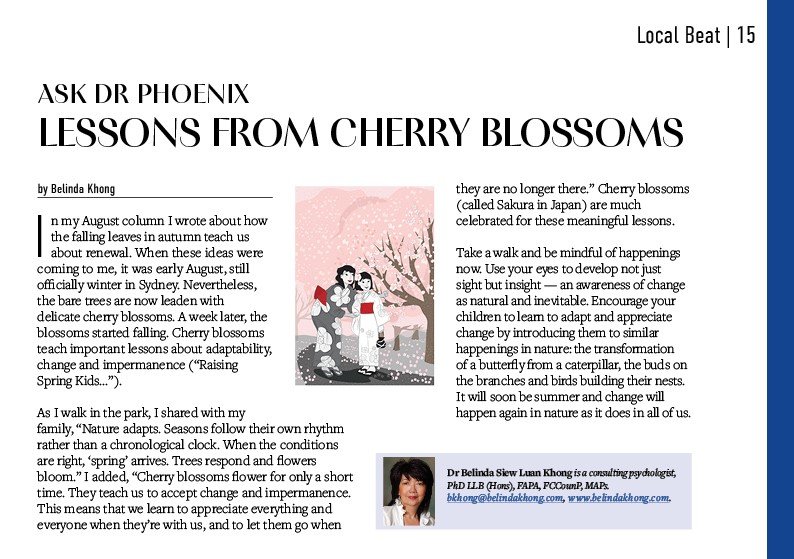
LESSONS FROM CHERRY BLOSSOMS

Spring is a special time to visit Japan. The cherry blossoms are in full bloom.  In my October column in the Sydney Observer Magazine (p.15) https://online.fliphtml5.com/wtpec/zyvo/#p=14, I write about the lessons that we can learn from these beautiful flowers.

It was early August in Sydney, not officially spring, and yet the trees are now wrapped with the delicate blooms. Cherry blossoms teach us important lessons about ADAPTABILITY, CHANGE and IMPERMANENCE. “Nature adapts and seasons follow their own rhythm, rather than a chronological clock. So when conditions are right, trees respond and flowers bloom.”

A week later, you will notice the blossoms starting to fall. Cherry blossoms flower for only a short time. They teach us to appreciate everything and everyone when they are with us, and to let go when they are no longer there.” Cherry blossoms are much celebrated in Japan for their beauty and for these meaningful lessons.

When you walk in the park, use your eyes to develop, not just sight, but insight - an awareness that change is natural and inevitable. Encourage your kids to learn to adapt and appreciate change as nature does - the transformation of a butterfly from a caterpillar and the buds on the bare  branches.

Soon it will be summer and change will take place in nature again, as it does in all of us.    

Resilience, Bullying and AI in Psychology

I had an interesting radio interview with 2 SER hosts, Campbell Steenbhom-Smith and Jessica Harrison based on my book, Raising Spring kids: A psychologist’s guide to nurturing mindful kids and my September column in the Sydney Observer magazine.

 We discussed the need to not overprotect kids but to help them develop resilience in coping with adversity and teach them the importance of not seeing themselves as victims by learning to respond rather than react to negative experiences such as bullying.

We also discussed the risks of using AI therapists in psychology and role play a counselling session with an AI therapist vs a real-life therapist.

Interview with 2 SER. FM 107.3. 2 September 2025.Listen now https://lnkd.in/gG_7ZyEz

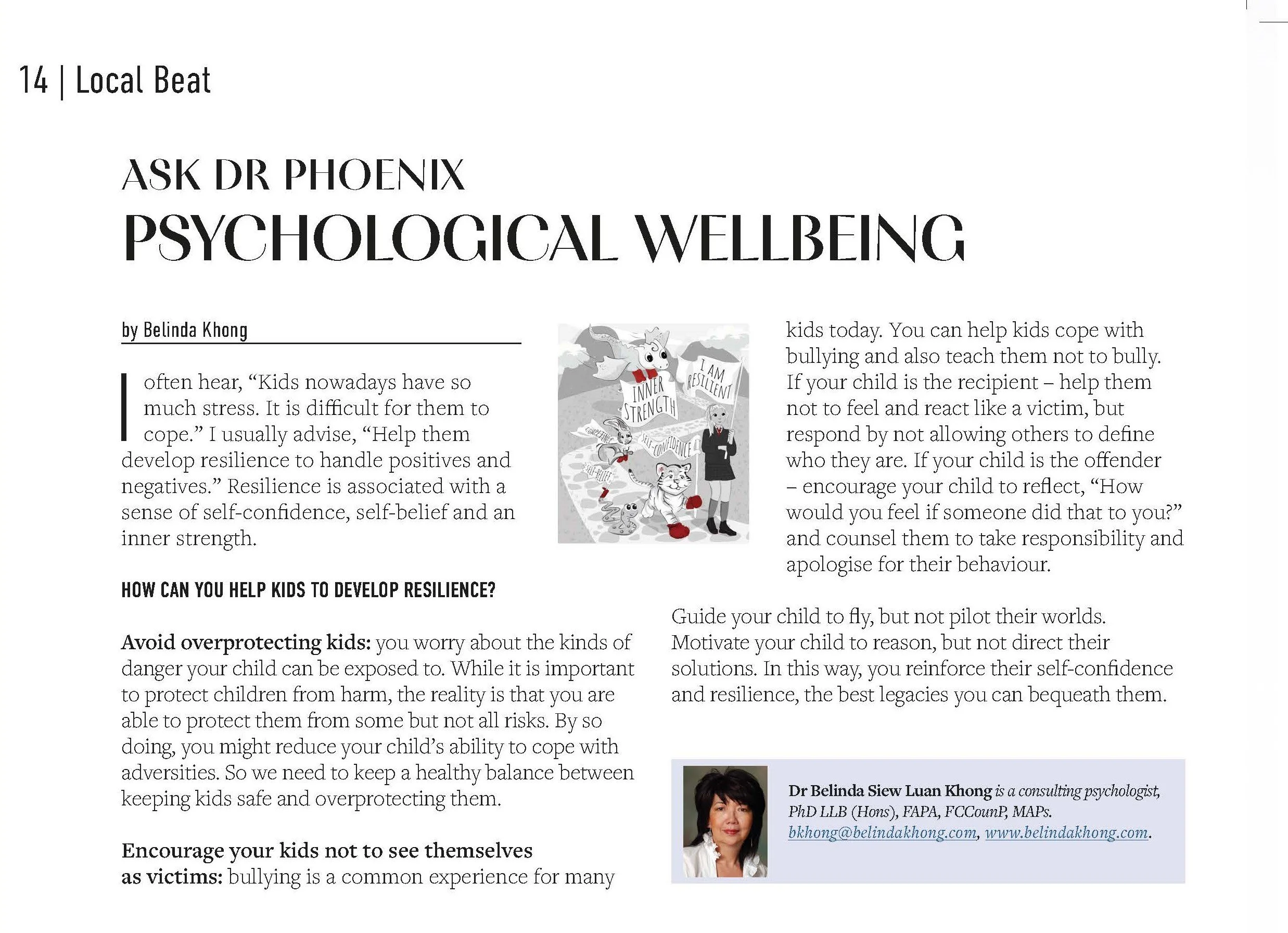
“CULTIVATING RESILIENCE FOR PSYCHOLOGICAL WELLBEING”

In my September column for the Sydney Observer magazine (p.14) https://sydneyobserver.com.au/wp-content/uploads/2025/08/Observer0925.pdf

I write about how to help kids to cope. I often hear “Kids nowadays are experiencing a lot of stress. It is difficult for them to cope.” I would advise “Help them cultivate  resilience.” In my view, resilience is one of the most essential attributes adults and kids can cultivate in developing psychological wellbeing.  

 What is resilience?

 Resilience speaks to an ability to manage and overcome adversities and obstacles, and to bounce back from challenging situations with adaptability. It is associated with a healthy sense of self-confidence, self-belief, competence, and an inner strength.

 Helping kids to be resilient

 How can you help kids to strengthen their sense of resilience? Here are some of my recommendations:

 · Avoid overprotecting kids

 It is important to protect kids from physical harm. However, the reality is that you would not be able to shield them from all risks.  If you try to do so, there is a significant likelihood of diminishing your children’s ability to be emotionally resilient and learn to cope with a range of situations. So we  need to keep a healthy balance between keeping  kids safe and overprotecting them. Offer kids choices about how to manage their concerns grounded on the belief that they could cope from the inside out while you support them to try out various options – the idea of teaching kids to fish, rather than giving them the fish. This is a good antidote to overprotecting your child.


· Help kids to work out answers themselves

 A resilient kid is one who is able to reason and problem-solve. I advise parents to stop hovering over their kids and piloting their worlds. In this age of instant information, you would be right in not allowing your child easy screen time on devices and  access to social media. I share similar beliefs. However for older kids who have to source information from the internet for research and schools projects, the issue is more complicated. How do kids learn to differentiate legitimate information from misinformation? It is important for older kids to develop the ability to reason for themselves and build the confidence to make informed decisions about what they read on the internet and not to do use social media indiscriminately. You can nurture this discernment skill by encouraging them to first work out their own answers. When you build up your kids’ confidence to think for themselves, you are reinforcing their self-belief that they will be able to use their power of reasoning to work through unfamiliar situations.


· Encourage kids not to see themselves as victims
We hear and read about kids being bullied in school or on social media and the negative impact these experiences have on their mental health. You can support your kids in coping with such negative actions by helping them to:

Appreciate that sometimes people may be acting from ignorance rather than malice
Not see themselves as victims and to use their resilience and inner strength to transcend the situation
Not let others define who they are and what they choose to be.

Each of us can be a victim or a hero in our personal journeys as we have the capacity to be the authors and editors of our lives. You can help foster children’s resilience and psychological well-being by helping them to cope and manage both the negatives and positives. 

“HOW NATURE TEACHES YOU ABOUT INTER-CONNECTEDNESS & RENEWAL”

Nowadays we are so caught up with global warming, net zero and renewals — the hubris of thinking that human beings know and can do better — we forget what a wonderful teacher NATURE is in its natural state. In my August column in the Sydney Observer magazine, p.15 (https://online.fliphtml5.com/wtpec/mlpq/#p=1), I discussed how nature in helping us experience change, inter-connectedness and renewal gives us hope and a sense of humility and grace, simple but important lessons for the human race.

I write about the renowned Buddhist monk, Thich Nhat Hanh’s conversation with the fallen autumn leaves, with the leaves expressing no fear or regrets since it was part of the whole tree, having nourished it in its growth, and now goes back to the soil to nourish the tree for its renewal in spring – a wonderful illustration of inter-connectedness and inter-dependence.

On a personal note, Nhat Hanh’s commentary brought back wonderful memories of my own encounter with interdependence. I have a rose garden, where I would pick roses. I observed myself searching for newly opened roses, ignoring the dead flowers on the ground. In a moment of mindful awareness, I realised that I had lost sight of the fact that the dead flowers came from the rose bush and would go back to nourish it. I had unwittingly judged one component of the whole to be more important or more beautiful than another.

 I also write about Catherine, the Princess of Wales sharing how nature helped her to heal after her experience with cancer—“the natural world's capacity to inspire us, to nurture us and help us heal and grow is boundless …."

 Interconnectedness and renewal can be difficult to appreciate but essential learnings in our being spiritual. If you observe a deciduous tree and the fallen leaves, you will appreciate the intimate connection with growth, life, death and renewal as Nhat Hanh and the Princess of Wales did. It is a humbling experience.

"THE YOUNGER GENERATION'S ADDICTION TO SCREEN AND PHONE TIME"

I recommend reading the timely, well-written article by Ros Thomas titled “Kids told us that they want to stop scrolling but they don’t know how” in the Weekend Australian Magazine (Aug 16, 2025).

https://www.theaustralian.com.au/weekend-australian-magazine/these-kids-told-us-they-want-to-stop-scrolling-but-they-dont-know-how/news-story/4e29c69ec64ecb9224658dff912dcd8c

Thomas interviewed Australian teenagers over a nine month period about how they feel about themselves on social media. According to Thomas, “the open secret among the under-16s is that they already know social media makes them feel bad about themselves. They just don’t know what to do about it.” A number of teenagers told Thomas that their screentime can last from 8 hours, 9 hours to early morning. She wrote about the concern of Jonathan Haidt, the best-selling author of  The Anxious Generation…”  (2024) that “parents have overprotected children in the real world …but vastly underprotected them in the virtual world” giving them “an iPhone and IPad” and saying “we ‘re going to let you be guided into adulthood by a bunch of random people on the internet chosen by algorithms…”

The negative impact on young minds described by Thomas is real, deeply troubling and needs to be taken seriously. As a psychologist, I have encountered young people with significant internet addiction and withdrawal symptoms when their devices are taken away. The impact on the whole family is devastating.

Fortunately, as Thomas’ shared, there are school principals like Barry Finch and Matt Hopkins who have taken the road less travelled and put a “blanket ban” on phones for their students in school despite student pushback. Finch and Hopkins also pointed to a group who can be said to be part of the problem. As Finch noted, “ Thirty percent of my time … is spent dealing with parents’ inability to parent, ….to do boundaries… to remove the phone…” Hopkins said, “Parents need to step up and do their job. And 100 percent of schools should be banning phones outright…”   

I admire their leadership and determination to do the right thing for young minds.

I believe that excessive screen time and social media addiction is responsible for one of society’s most consequential mental health crisis. I highly recommend educators and parents read this meaningful article. Share them with kids and give them the opportunity to make an informed decision about stopping before this addiction takes over their lives.

“DIFFERENTIATING WHAT WE WANT FROM WHAT WE NEED”

In this age of entitlement, the catch-cry is often for “More and more”- more screen time, more devices, more money, more entertainment etc. Do we really need more or do we just want more? In my July column in the Sydney Observer magazine, I discuss the importance of differentiating between WANTS and NEEDS.

Needs speak to basic things that are important, usually necessities. Wants are usually about things that would be nice to have - desires or wishes. I learned this valuable distinction at my first meditation retreat where we were invited to eat one daily meal in keeping with the Buddhist practice. I piled a lot of food on my plate, worried that I might go hungry later. When told by my meditation teacher that we have to eat everything on our plates, I realised that I wanted more food than I really needed. As my meditation teacher noted, “A grateful heart turns what we have into enough.” Appreciating and acknowledging that we have enough acts as a buffer to many psychological problems for the young and old.

To read the full article (p.10)  

https://sydneyobserver.com.au/wp-content/uploads/2025/07/Observer0725.pdf

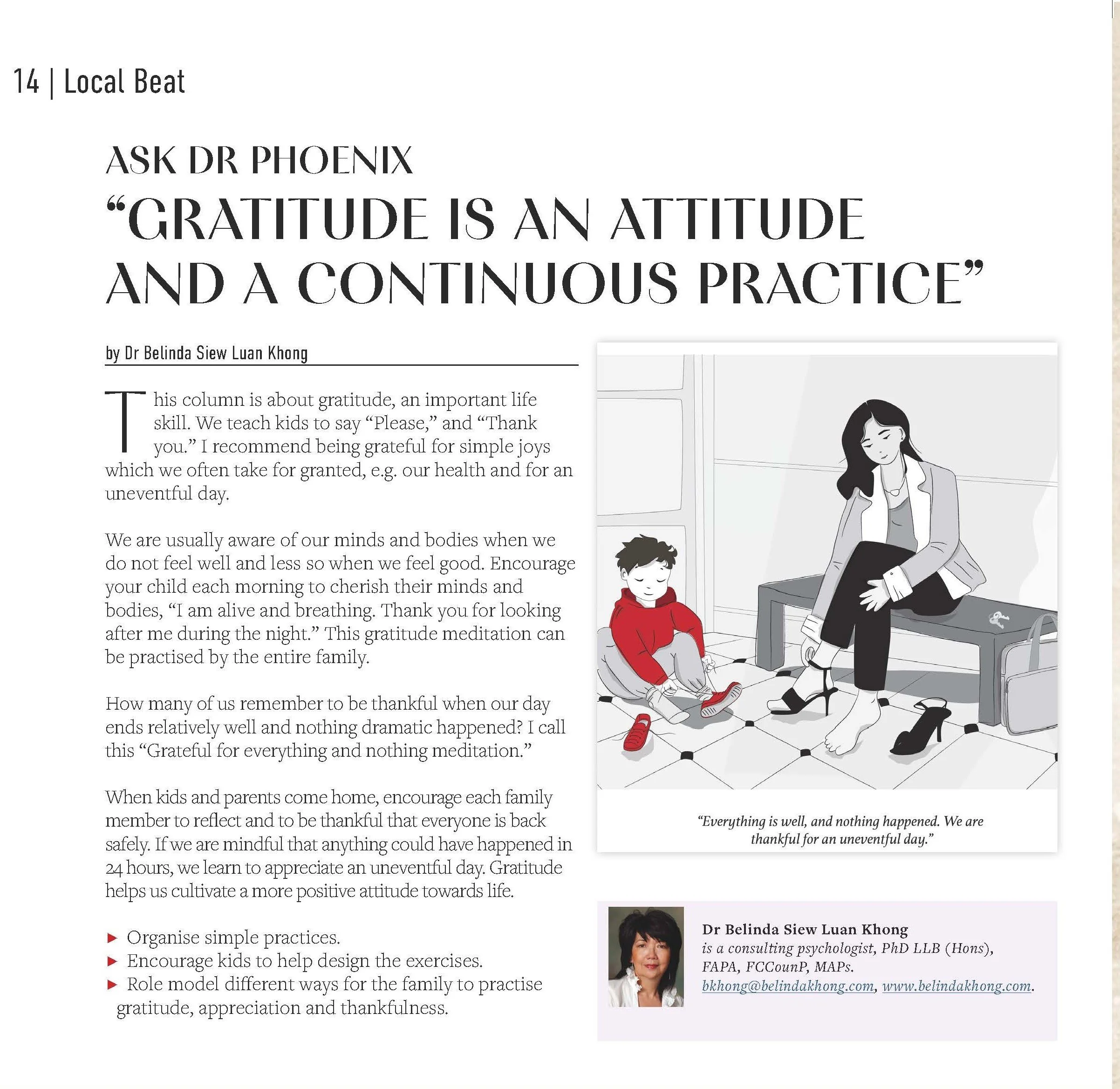
“GRATITUDE IS AN ATTITUDE AND A CONTINUOUS PRACTICE ”

In my June column for the Sydney Observer magazine (p.14), I write about cultivating gratitude as an important life skill. We are usually aware of our minds and bodies when we are not feeling well, or when something goes wrong with our day. That is, we are more focused on negatives. I encourage you to practise gratitude for simple joys which we may take for granted:

·      Our health - to simply appreciate being alive and breathing - a “gratitude meditation” which can be practised by the whole family daily and

·      An uneventful/neutral day-If we are mindful that anything could have happened in 24 hours - we can appreciate when our day ends well and nothing dramatic happened. I call this meditation “Grateful for everything and nothing meditation.”

I believe that continually wrapping ourselves with a sense of gratefulness for simple happenings is a powerful contributor to good mental health and a positive attitude. There are no expenses involved and no negative side effect to this sense of calm awareness.

For the full article, see Sydney Observer (June issue, '25, p.14)
https://online.fliphtml5.com/wtpec/yroa/#p=1

“NO CHILD HAS DIED FROM BOREDOM”

One of the important challenges for families and kids is the frequent use of social media, the internet and mobile devices. I believe the significant amount of screen and device time used by parents to nanny their kids, pose one of the greatest catalyst of the mental health crisis. In my May column, I wrote about how no child has died from boredom and the psychological and emotional risks for kids when parents use their mobile to nanny their kids  and for parents to refrain from doing so.

NO CHILD HAS DIED FROM BOREDOM!"
For the full article, see Sydney Observer (May issue, '25, p.14)
https://sydneyobserver.com.au/.../2025/05/Observer0525.pdf

ACKNOWLEDGMENT IN THE NSW PARLIAMENT

 I wish to express my deep gratitude to Matt Cross, MP, Member for Davidson for his acknowledgement of my fourth book, Raising Spring Kids: A Psychologist’s Guide to Nurturing Mindful kids in a COMMUNITY RECOGNITION STATEMENT to the NSW Parliament on 7 May 2025.

 “One of the greatest privileges I have as the Member for Davidson is to acknowledge the inspiring and valuable work taking place in the community. This recognition of your work as a psychologist, writer, teacher and educator, in the official parliamentary record, Hansard, is important both for history and to recognise the enormous contribution you have made over many years to our community and to society, through your insightful and meaningful books and innovative teachings. … Congratulations once again on being recognised in the NSW Parliament.”

Matt acknowledged Alister Henskens, SC, MP, the Member for Wahroonga for officially launching and celebrating my book on 26 April 2025.

I thank my various Members of Parliament for their generous commendations and support of my work and vision for promoting positive values.  

NSW SENIORS LOCAL ACHIEVEMENT AWARD 2025 & ACKNOWLEDGMENT IN NSW PARLIAMENT

I am pleased to share the NSW Seniors Local Achievement Award presented by my State Member of Parliament, Matt Cross, Member for Davidson. The award is for my contributions to children’s literature, writing on positive values and promoting cultural understanding. Matt  also recognised the award in the NSW parliament.

My thanks to Matt Cross for supporting my work, books and my passion for promoting good mental health, well-being  and positive flourishing.

COMMUNITY RECOGNITION STATEMENT ABOUT DRAGON AND FRIENDS’ MINDFUL ADVENTURES

I am delighted to share the Community Recognition Statement organised by my Member of Parliament, Mr Matt Cross, MP, Member for Davidson. I attach the beautiful Community Recognition Certificate, which will have a place of pride in my home. 

My thanks to Mr Matt Cross for his generous support and acknowledgement of my work and books in the NSW Parliament

WE CAN DO BETTER BY OUR KIDS AND FAMILIES IN MENTAL HEALTH!


As a psychologist, I continue to worry about the high level of medication of antipsychotic drugs and Ritalin being prescribed to kids in Australia and internationally.

A study by the University of Adelaide researchers in 2022 (Australian & New Zealand Journal of Psychiatry, 56(11), 1477–1490 found that:

View the full article here

A recent article in The Economist “How to stop over–medicalising mental health" (7 Dec 2023) sounded the alarm that Britain is over-medicalising the population, and offered this important, timely advice:

View the full article here

YES, COMPASSION NEEDS TO BE COMPLEMENTED BY THOUGHTFULNESS.

This is what my book series offers.

https://www.belindakhong.com/lunar-new-year-animal-adventures-books-for-kids

My latest book–Dragon and Friends’ Mindful Adventures: The Great Race Again!, the third installment in the series, Lunar New Year Animal Books for Kids, is now published and will be officially launched in Sydney on Saturday, 23 March 2024 to celebrate the year of the Wood Dragon.

https://www.belindakhong.com/dragon-friends-mindful-adventures

The book promotes the important values of gratitude, appreciation, mindfulness, selflessness and compassion—important antidotes to many mental health problems.

Recently, I was invited to do a radio Interview with 2SER, Sydney. I discussed my concerns with the over-prescription of strong medication, and the impact of such powerful drugs on young minds. I further explored how we can foster kids’ well-being and development by encouraging them to learn from books that promote the integration of approaches from Eastern and Western psychologies and philosophies.

Listen to the 2SER radio interview here.

While medication has a role in managing some mental health issues, I believe that we can do better for our kids by offering them another approach that focuses on their strengths rather than their deficits.

YOUNG MINDS DESERVE BETTER THAN STRONG PRESCRIPTIVE MEDICATION!