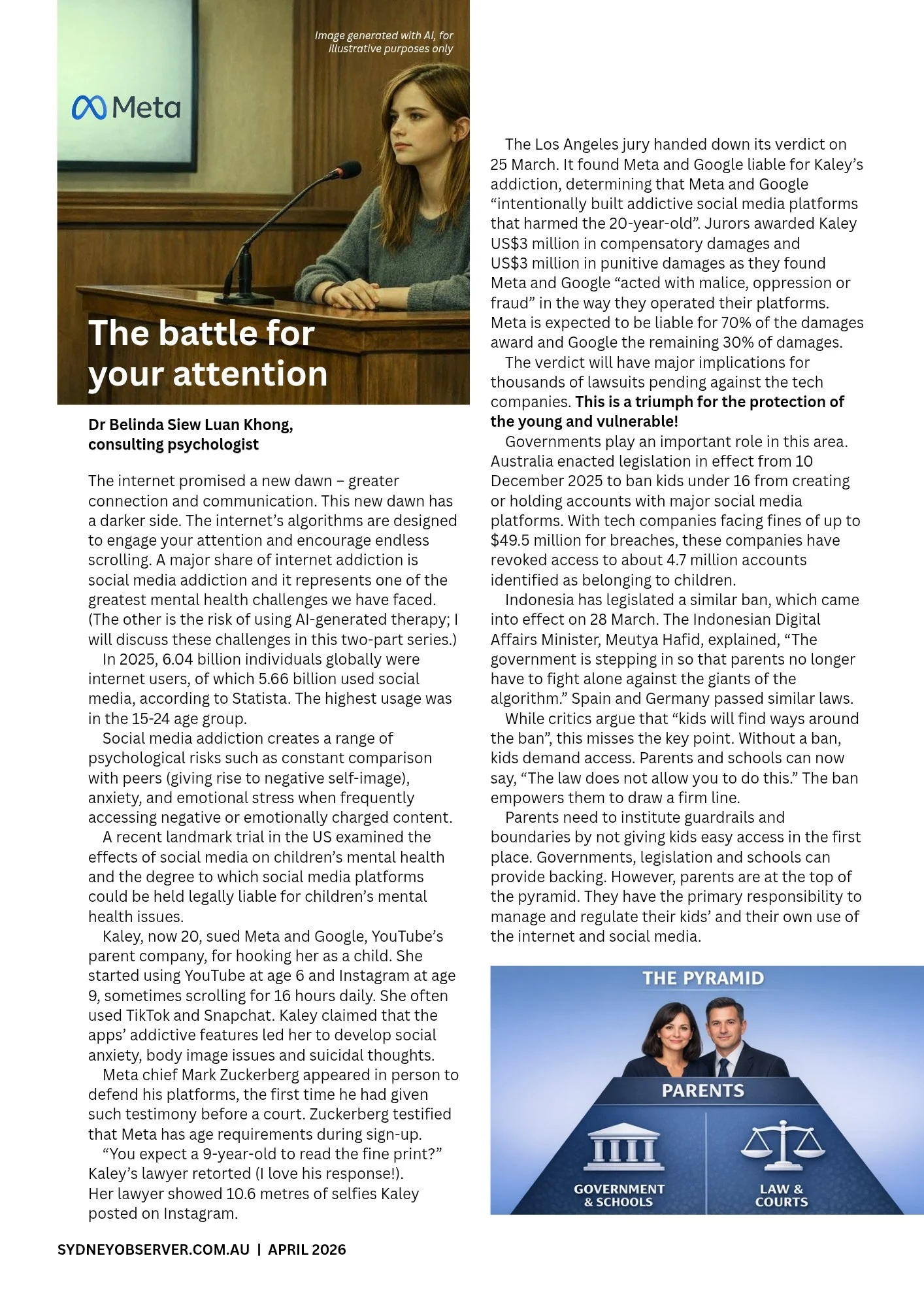
The internet promises a new dawn for greater connection and communication. In this 2-part series, I write about social media addiction in my April column for the Sydney Observer https://sydneyobserver.com.au/wp-content/uploads/2026/03/Observer-April-2026-Digital-Editon.pdf, p. 14). In the May issue I write about the risk of using AI-generated therapy in mental health.
The algorithms of the internet are designed to capture your attention and promote endless scrolling. As of October 2025, 6.04 billion individuals worldwide are internet users of which 5.66 billion use social media. Internet usage are highest in the 15-24 year group. Prolonged use of social media can result in compulsive behaviour and addiction, involving many psychological risks such as constant comparison with peers giving rise to negative self-image; anxiety, depression and stress when constantly accessing negative or emotionally charged content.
A recent landmark case in Los Angeles examined the effects of social media on children’s mental health by the tech platforms. Kaley, a 20-year-old woman accused Meta and YouTube of designing addictive features to hook her as a small child. She started using social media young - YouTube at age 6, Instagram at 9, sometimes scrolling for more than 16 hours daily. She was a frequent user of TikTok and Snapchat. Kaley claimed the apps addictive features led her to develop social anxiety, body image issues and suicidal thoughts which worsened as she became hooked ((https://www.npr.org/2026/02/18/nx-s1-5717117/zuckerberg-testimony-social-media-addiction-trial)
Kaley’s lawyer, Mark Lanier shared that over 4 million Instagram users were under 13. Meta’s chief, Mark Zuckerberg testified that Meta has age requirements during the sign-up process. “You expect a 9-year-old to read the fine print,” Lanier retorted (I love his response!). Lanier showed the court 10.66 metres of selfies which Kaley posted to Instagram.
As a lawyer and psychologist I found the trial fascinating and very informative from the legal, psychological and long-term impact for the tech companies and users. You might find the information helpful.
Legal arguments
Section 230 of the US 1996 Communications Decency Act protects the tech companies from responsibility for contents posted. The tech companies have got away with this argument for years when they were sued for the contents on their platform.
Kaley’s lawyer Lanier took a novel approach. By the way, he was the attorney who won the massive class action against Johnson & Johnson for the contaminated baby products. Lanier filed a suit for product liability and defect. He argued that the tech companies have built platforms which are not fit for purpose. He said that the construction of the platforms is designed to be addictive especially to young minds - the likes, notifications and continuous pop-ups of interesting contents based on the algorithms of the user’s search and scrolling. The jury agreed. Lanier was able to subpoena internal documents in Meta which showed Zuckerberg asking his people to target 13-year olds, one of their biggest audience. They also accessed documents where Meta’s employees warned Zuckerberg that the platforms are addictive and will negatively impact on young minds. Zukerberg and management ignored the warnings and continued to go for young minds. I agree with this argument
Psychological factor
There is also the psychological factor. Meta’s lawyers argued that Kaley had prior mental health issues and came from a dysfunctional home environment and that the social media wasn’t responsible for her mental health (blaming the victim argument).
Verdict
The judge rightly differentiated between contents (which is protected by S230) and construction of the platform (hence the product liability argument). (https://www.bbc.com/news/articles/c747x7gz249o). The Los Angeles jury handed down its verdict on 25 March 2026. It found Meta and Google liable for Kaley’s addiction, determining that Meta and Google “intentionally built addictive social media platforms that harmed the 20-year old.” The court awarded Kaley US$3 million, compensatory damages and US$3 million, punitive damages and found Meta and Google “acted with malice, oppression or fraud … ” . Meta is liable for 70% and Google, 30% of the damages (https://www.bbc.com/news/articles/c747x7gz249o). The Los Angeles trial is a bellwether case tied to 1,600 similar suits filed by families and schools in the US and globally. A triumph for protection of the young and vulnerable!
Guardrails - Social media ban
The legal cases brought against the social media companies demonstrate that users are waking up the harm of this addiction. Governments and the courts are putting in guard rails.
From 10 Dec, 2025, Australia banned under-16’s from accessing major social media platforms. To date the tech companies have revoked access to about 4.7 million accounts identified as belonging to children. Indonesia passed a similar law (WEF March 28 2026) aimed at protecting children from online harm including social media, online gaming and e-commerce platforms. Spain and Germany have passed similar laws.
Critics argue, “Kids will find ways around the ban.” This misses the key point. Without the ban, kids will demand access. Parents and schools can now say, “The law does not allow you to do this.” The ban empowers them to draw a firm line.
Parents have the primary responsibility
While governments, laws, courts and schools can provide the support and backing, parents are at the top of the pyramid. They have to exercise the discipline in not giving kids easy access in the first place. At a public talk I gave in Jakarta last week, a parent asked, “How can parents stop this internet scourge?” I replied, ”It is not rocket science. Stop being the tech companies’ co-conspirators. Your child cannot purchase, charge or turn on a device. You can. You have the primary responsibility to manage and regulate your kids’ and your own use of the internet and social media.”